
Many students believe that they have a poor memory. They attend a lesson, understand what the teacher explains and perhaps even feel confident about the subject. However, when they try to remember the same information a few days later, much of it seems to have disappeared.
This does not necessarily mean that they have a weak memory. In many cases, the real problem is the way the information was learned and reviewed.
Reading a lesson repeatedly, highlighting several pages or looking over notes for hours may create a feeling of familiarity. The material begins to look familiar, so the student assumes it has been learned. But recognising information when it is in front of us is different from recalling it independently when we need it.
Effective learning is not simply about putting information into the mind. It is about building knowledge that can be retrieved, understood and applied later.
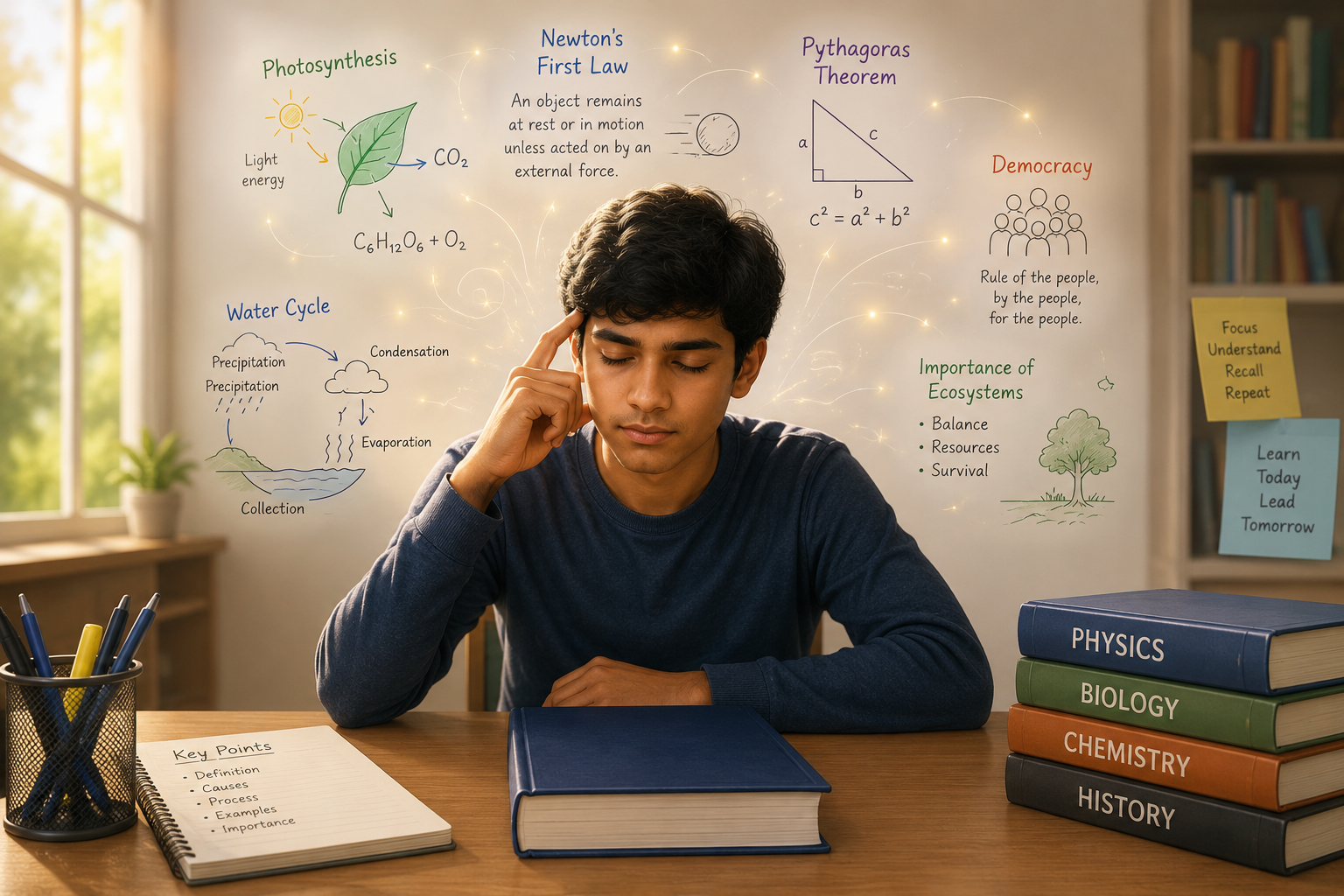
Memory Is Not a Recording Device
Human memory does not work like a video camera that records everything exactly as it happens. We notice some information, ignore other information, interpret what we experience and connect new ideas with what we already know.
Memory can be understood through three broad processes:
- Encoding – receiving and making sense of new information
- Storage – maintaining that information over time
- Retrieval – bringing the information back when it is needed
A student may fail to remember something because the information was not properly understood at the beginning. In other cases, it may have been understood but not reviewed sufficiently. Sometimes the knowledge is still present, but the student cannot retrieve it under examination conditions.
Therefore, improving memory requires more than repeating information. It requires improving attention, understanding, organisation, review and retrieval.
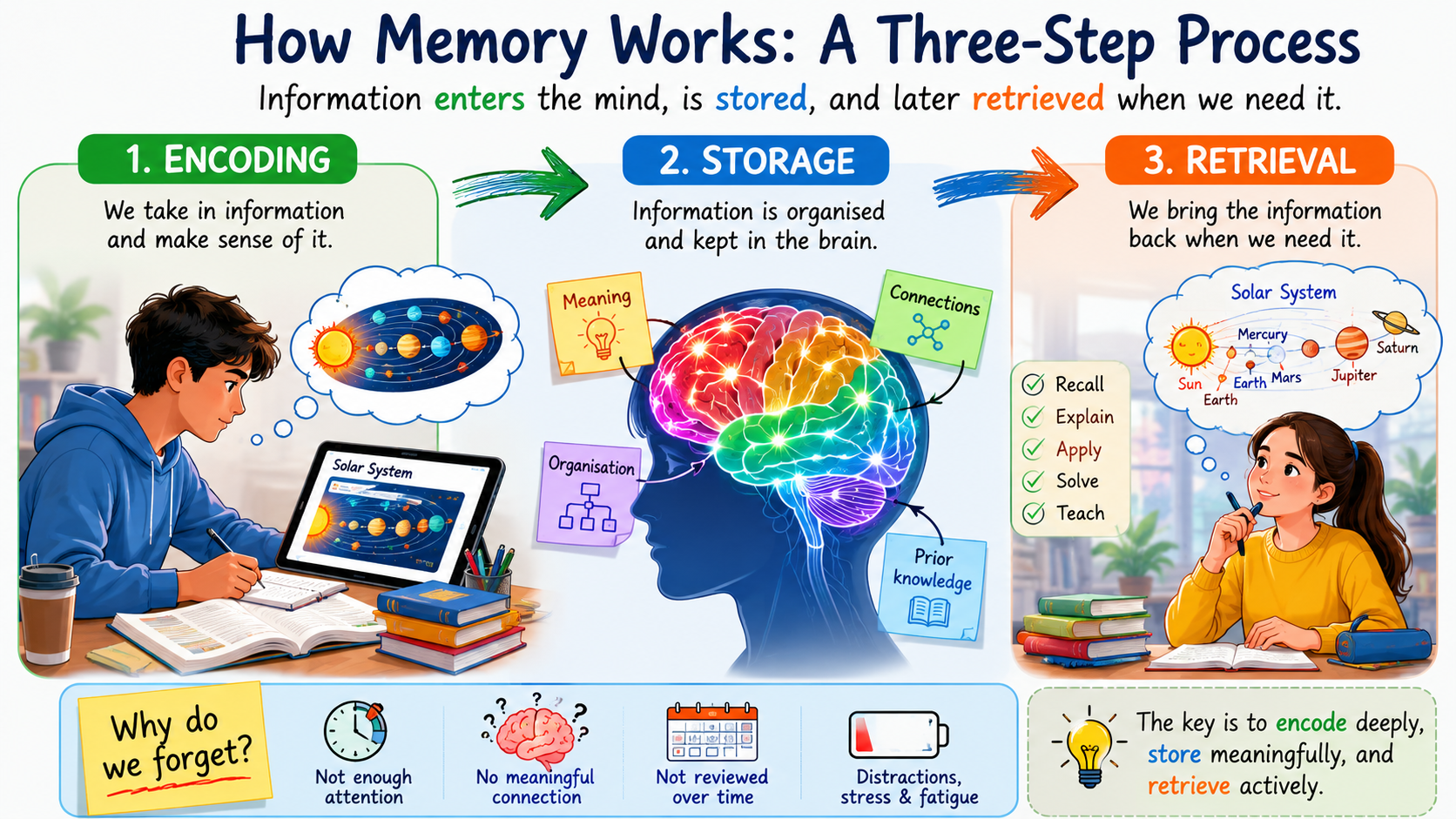
Why We Forget
Forgetting is a normal part of learning. The mind receives far more information than it can treat as permanently important. Information that is not revisited, used or connected meaningfully with other knowledge becomes increasingly difficult to retrieve.
Forgetting can happen for several reasons:
- The learner did not pay enough attention.
- The information was memorised without understanding.
- Too much material was studied in one session.
- Similar information became confused.
- The lesson was not reviewed after it was first learned.
- The learner repeatedly read the material but never practised recalling it.
- Tiredness, stress or distraction interfered with learning.
- The knowledge was learned only for a short-term test and was not used afterwards.
Forgetting should not always be viewed as failure. A small amount of forgetting between study sessions can actually make the next review more valuable. When we make an effort to retrieve information that has become slightly difficult to remember, the memory can become stronger.
The important point is not to avoid forgetting completely. It is to revisit the knowledge before it becomes inaccessible.
Understanding Is the Foundation of Memory
Students sometimes try to memorise words without understanding the ideas behind them. This may work briefly, but the knowledge is usually fragile.
Meaningful information is generally easier to remember than disconnected information. When learning a new concept, ask:
- What does this mean?
- Why is it important?
- How does it work?
- What caused it?
- What are its consequences?
- How is it connected to something I already know?
- Can I think of a real-life example?
- How would I explain it in my own words?
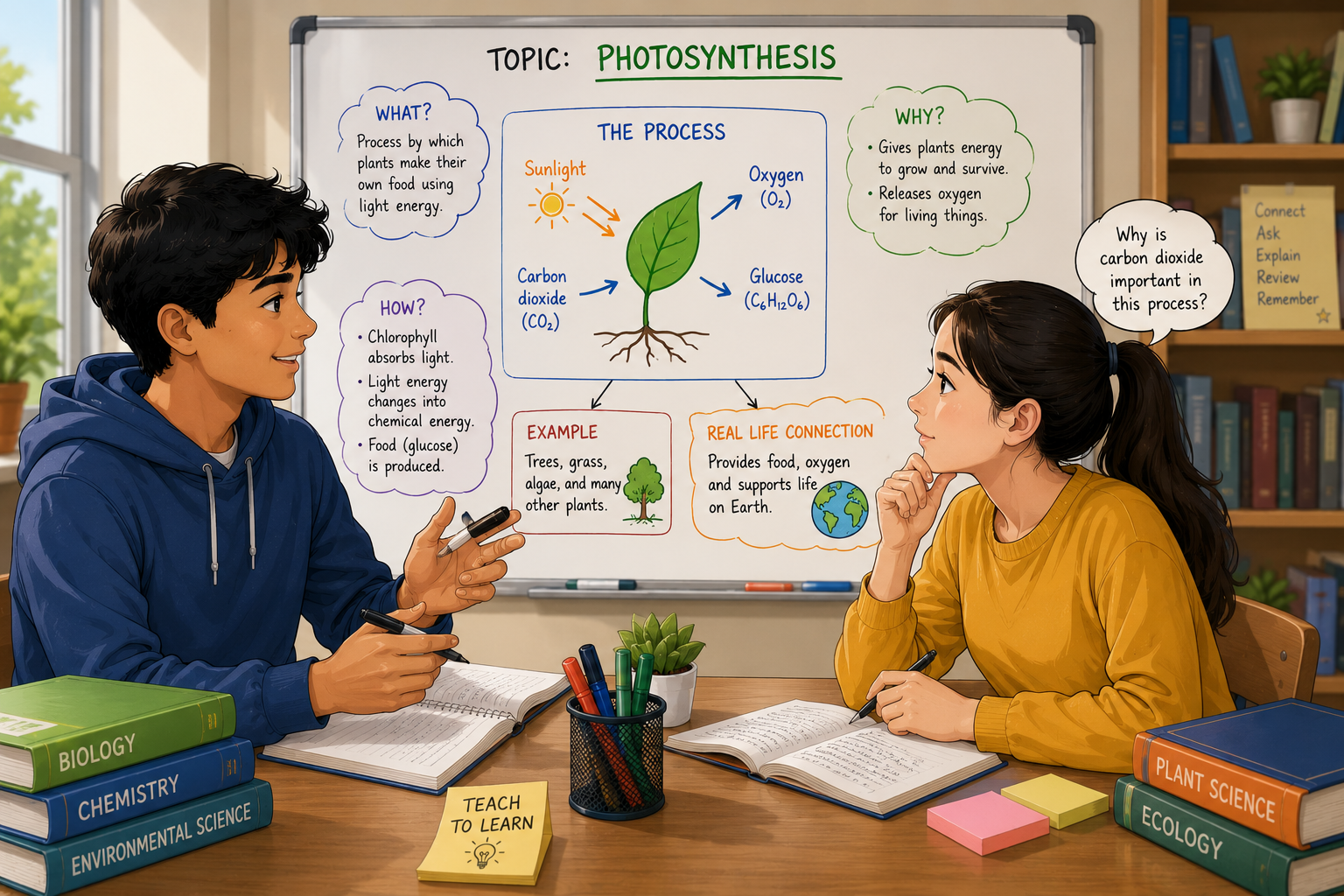
Consider a student learning the process of photosynthesis. Memorising the definition word for word may help with one question. However, understanding why plants need light, how energy is transformed and how the process supports other living organisms creates a network of connected knowledge.
The stronger the network of meaning, the more possible routes the mind has for retrieving the information later.
Active Recall: Practise Remembering, Not Just Reading
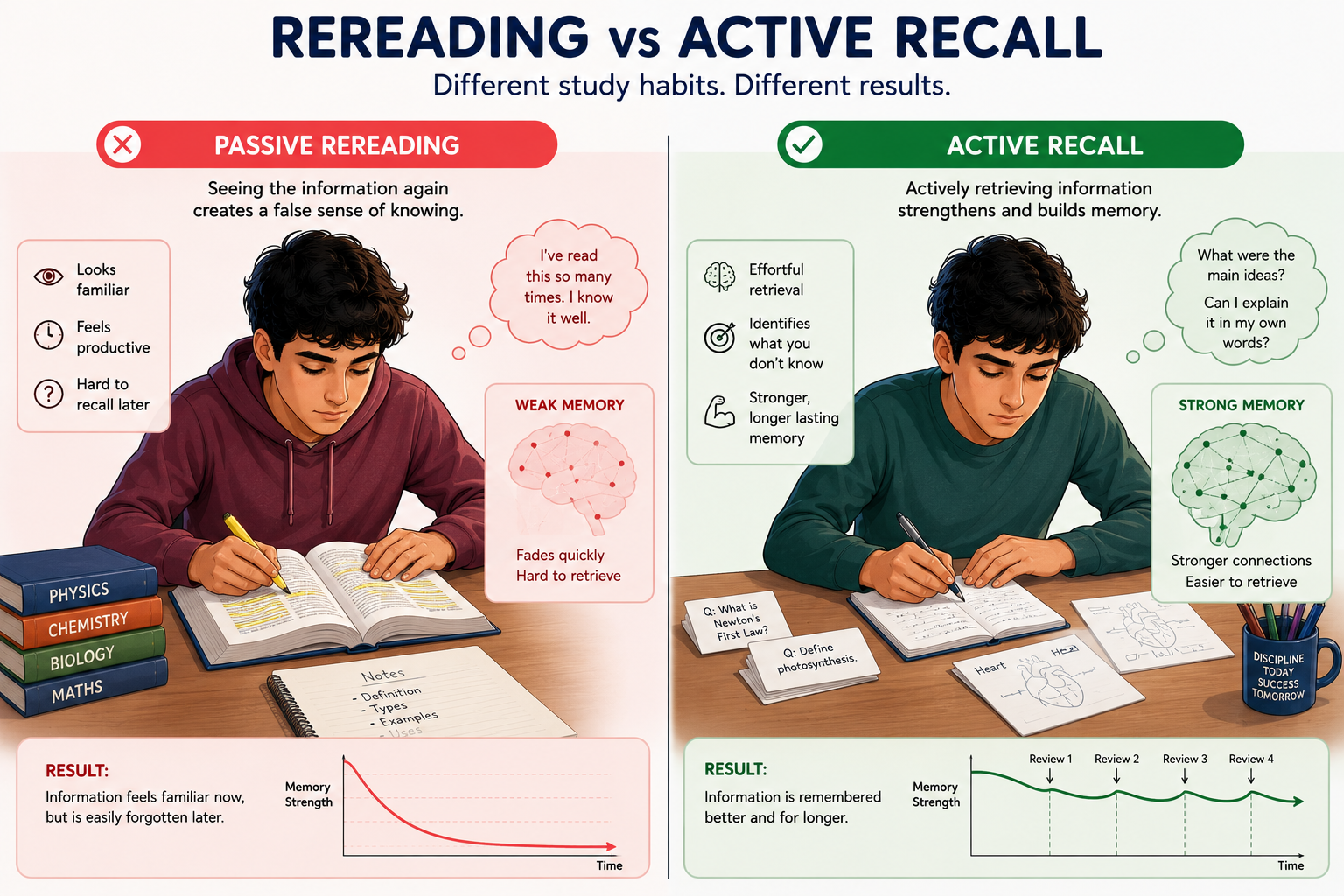
One of the most effective ways to strengthen memory is active recall.
Active recall means attempting to bring information to mind without first looking at the answer. Instead of reading the same page several times, the learner closes the book and tries to remember the main points.
For example, after completing a lesson, a student can ask:
- What were the three main ideas?
- Can I define the key terms?
- What steps were explained?
- What examples were used?
- Can I draw the diagram from memory?
- Can I answer a question without checking my notes?
The attempt to retrieve the information is important, even when the answer is incomplete. Struggling briefly to remember is not evidence that the method is failing. That mental effort is part of what makes the learning effective.
After attempting an answer, the learner should check the source, identify mistakes and correct them. Active recall should not mean repeatedly practising incorrect information.
Useful active-recall methods include:
- Answering practice questions
- Using flashcards
- Writing a summary from memory
- Drawing diagrams without looking at the original
- Explaining a concept aloud
- Completing past examination questions
- Asking a friend to quiz you
- Creating questions from a lesson and answering them later
Tests should therefore not be viewed only as instruments for giving marks. A low-pressure self-test is also a learning activity. It reveals what the learner truly knows and strengthens access to that knowledge.
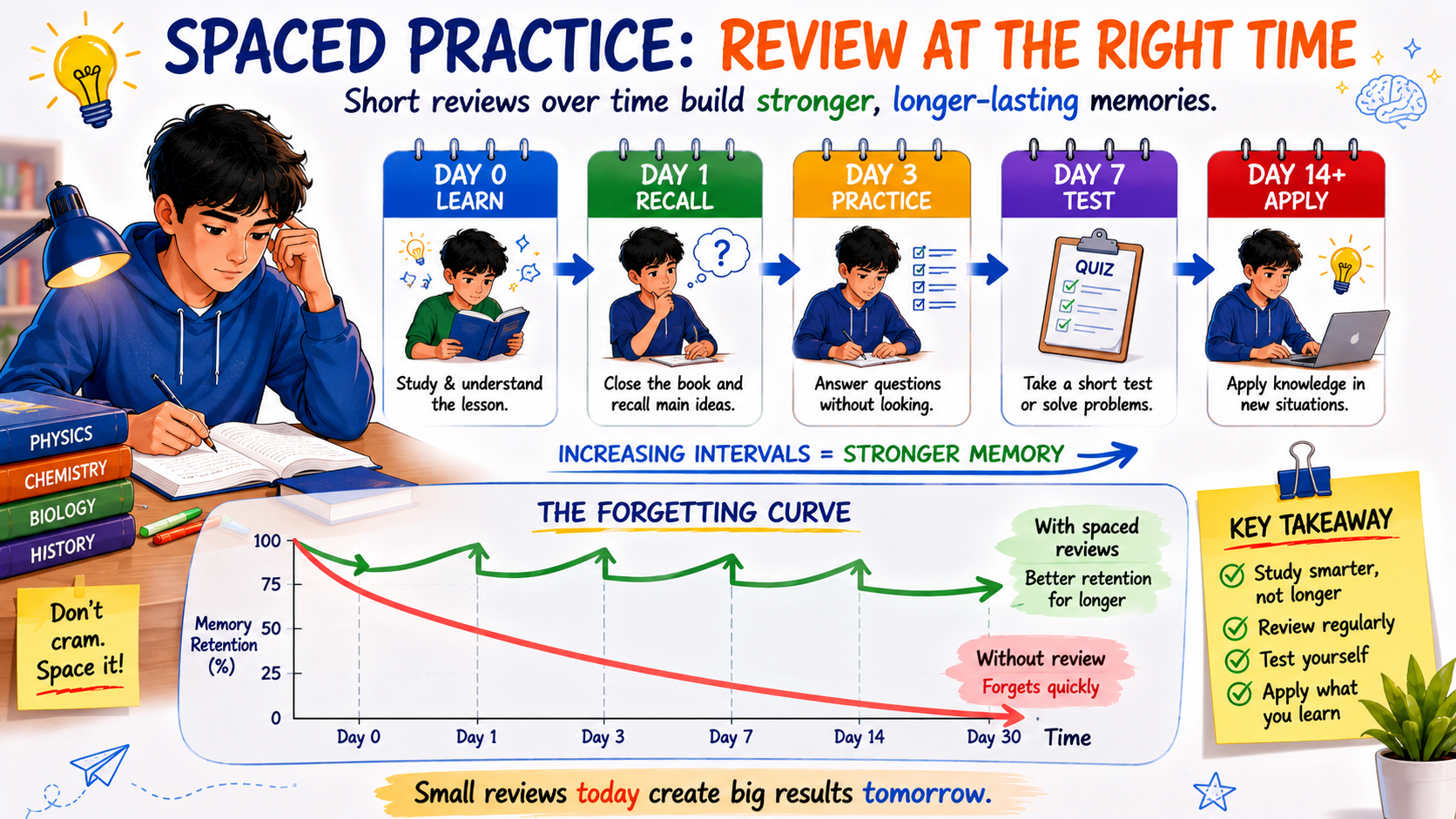
Spaced Practice: Review at the Right Time
Many students wait until the night before an examination and attempt to study everything at once. This is known as cramming.
Cramming may help a student keep information available for a short time. However, much of it can be forgotten soon after the examination because the knowledge was not strengthened across multiple occasions.
A better approach is spaced practice. This means dividing learning into shorter sessions spread over time.
A simple review schedule might look like this:
- First review: later on the same day
- Second review: the following day
- Third review: after three or four days
- Fourth review: after one week
- Fifth review: after two or three weeks
- Later reviews: as necessary
The exact intervals do not have to be identical for every subject or learner. Difficult material may need to be reviewed more frequently. Well-understood material can be reviewed after longer gaps.
Each review should involve active recall rather than passive rereading. For example, before opening the notes, spend five minutes writing down everything you can remember. Then compare your answer with the lesson and fill in the missing details.
Spacing works partly because each session requires the learner to reconstruct the knowledge. That reconstruction makes the memory more durable.
Repetition Is Useful Only When It Is Meaningful
Repetition is often presented as the main secret of memory. However, not all repetition is equally useful.
Repeating a sentence ten times without thinking about its meaning is different from recalling it, explaining it, applying it and connecting it with other ideas.
Passive repetition may create familiarity. Productive repetition creates understanding and retrieval strength.
A better pattern is:
Learn → close the material → recall → check → correct → wait → recall again
This process is more mentally demanding than rereading, but that is precisely why it is more useful.
Explain the Lesson to Someone Else
Teaching is a powerful way to identify whether something has been properly understood.
When students explain a concept to another person, they must organise their thoughts, choose suitable words and connect the different parts of the idea. Weaknesses that remain hidden during silent reading become obvious during explanation.
You do not always need another person. You can explain the lesson to:
- A classmate
- A family member
- An imaginary student
- A voice recorder
- Yourself while standing in front of a whiteboard
Try to explain the subject in simple language. Avoid hiding behind technical terms. When an idea cannot be explained simply, it may not yet be fully understood.
A useful exercise is to imagine that you are teaching someone who has never studied the subject. Begin with the basic idea, introduce the important terms, provide an example and explain how the parts are connected.
Use Elaboration: Ask “Why?” and “How?”
Elaboration means adding meaning to new information by connecting it with reasons, examples, comparisons and existing knowledge.
Suppose a student learns that metal expands when heated. Instead of memorising the sentence alone, the student might ask:
- Why does expansion occur?
- Where can this be observed?
- Why are gaps left between railway tracks?
- What could happen if engineers ignored thermal expansion?
- Does every material expand at the same rate?
Each question creates an additional connection. These connections make the knowledge easier to understand and retrieve.
However, explanations should be checked against reliable learning materials. A confident but incorrect explanation can strengthen a misconception.
Mix Related Types of Problems
Students often practise one type of problem repeatedly before moving to the next type. This is known as blocked practice. It can make the activity feel easy because the learner already knows which method to use.
A more challenging approach is to mix related types of problems. This is known as interleaving.
For example, rather than completing twenty questions using the same mathematical formula, a student can mix questions that require different methods. The student must then decide which method is appropriate instead of applying the same procedure automatically.
Interleaving may feel slower and more difficult. However, it can improve the learner’s ability to distinguish between problem types and select the correct strategy independently.
It is most useful when the topics are related enough to be compared but different enough to require different decisions.
Connect Words with Images and Structure
Visual methods can support memory when they help the learner understand relationships.
Useful techniques include:
- Concept maps
- Flowcharts
- Timelines
- Tables
- Labelled diagrams
- Mind maps
- Comparison charts
- Cause-and-effect chains
A diagram should not merely decorate the notes. It should show how ideas are connected.
For example, a history timeline can show the order of events, while a cause-and-effect map can show why those events occurred. In science, a flowchart can represent the stages of a process. In literature, a character map can show relationships and conflicts.
Creating the visual representation from memory is more powerful than simply looking at one prepared by someone else.
Use Mnemonics Carefully
Mnemonics are memory aids such as acronyms, rhymes, phrases and mental images. They can be useful for remembering ordered or arbitrary information.
For example, a student may create a sentence in which the first letter of each word represents the items in a list.
Mnemonics are helpful when the information itself has no obvious logical structure. However, they should not replace understanding. Remembering the first letters of several scientific terms is not the same as understanding what those terms mean.
Use mnemonics as hooks for retrieval, not as substitutes for knowledge.
Attention Comes Before Memory
It is difficult to remember information that was never fully attended to.
Studying while constantly checking messages, watching short videos or switching between applications divides attention. The learner may spend a long time with the book open while completing very little deep learning.
A focused 30-minute session can be more valuable than two hours of interrupted study.
Before beginning:
- Keep only the necessary materials nearby.
- Silence unnecessary notifications.
- Decide what you intend to complete.
- Work on one learning task at a time.
- Take a short break when concentration declines.
- Keep the phone physically out of reach when possible.
Attention is not unlimited. It becomes weaker with fatigue, stress and prolonged effort. Effective learners manage their attention rather than simply forcing themselves to remain at a desk for many hours.
Sleep, Rest and Physical Well-Being
Learning does not end when the book is closed. The brain continues to process and stabilise memories after the study session.
Adequate sleep supports concentration, learning and later recall. Studying throughout the night may provide additional hours, but the loss of sleep can reduce the learner’s ability to think clearly and remember accurately.
Regular physical activity, sufficient rest and sensible nutrition also support the conditions needed for learning. These are not magical memory techniques, but they influence attention, energy and mental performance.
Breaks are also useful. A break should allow the mind to recover, not introduce a new stream of distracting information that makes returning to the lesson more difficult.
Interest and Emotion Influence Learning
People often remember experiences that are personally meaningful, surprising, emotional or connected to their goals.
Interest increases attention and encourages deeper engagement. However, students cannot depend entirely on naturally liking every subject. Part of effective learning is learning how to create interest.
A learner can make an unfamiliar subject more meaningful by asking:
- Where is this used in real life?
- How does this affect people?
- What problem does this knowledge solve?
- How is it connected to my future goals?
- What is unusual or surprising about it?
- Can I turn it into a question or challenge?
Positive emotion can support learning, but extreme anxiety may interfere with attention and recall. Students who experience examination anxiety should practise recalling information under gradually more realistic test conditions. Familiarity with the process can reduce uncertainty.
Why Familiarity Can Be Misleading
One of the greatest problems in studying is the illusion of learning.
After reading the same page several times, the words become easy to recognise. This ease can be mistaken for mastery. But when the book is removed, the learner may be unable to reproduce or apply the information.
To avoid this illusion, replace the question “Does this look familiar?” with more demanding questions:
- Can I explain it without looking?
- Can I solve a new problem using it?
- Can I distinguish it from a similar idea?
- Can I identify my own mistakes?
- Can I remember it after several days?
- Can I use it in a different context?
Learning should be judged by what can be produced independently, not by how comfortable the material feels while it is being read.
Mistakes Are Part of Effective Learning
Students sometimes avoid self-testing because they do not want to discover that they have forgotten something. However, mistakes provide useful information.
An error shows exactly where more learning is required. When the learner identifies the reason for the mistake and corrects it, the correction can become memorable.
The important sequence is:
- Attempt the question.
- Identify the error.
- Understand why it occurred.
- Study the correct explanation.
- Answer the question again later.
Simply looking at the correct answer is not enough. The learner should reconstruct the reasoning.
A mistake that is carefully corrected can contribute more to learning than an easy answer produced without thought.
Adapt the Method to the Subject
Different subjects require different forms of retrieval and practice.
For mathematics and physics
Practise solving unfamiliar problems. Do not only read worked examples. Mix different problem types and explain why each formula or method applies.
For science
Recall definitions, draw and label diagrams, explain processes, predict outcomes and connect theory with experiments or real-world examples.
For history
Construct timelines, compare events, explain causes and consequences and evaluate different interpretations.
For languages
Retrieve vocabulary, create sentences, practise speaking, write from memory and encounter words in different contexts.
For literature
Recall key events, analyse themes, compare characters and support interpretations with evidence from the text.
For technical or professional subjects
Practise troubleshooting, explain systems, create diagrams, work through scenarios and apply principles to realistic cases.
The common principle is that study activities should resemble the way the knowledge will eventually be used.
A Practical Study Routine
The following routine combines understanding, active recall and spaced review.
Before the lesson
Spend a few minutes previewing the topic. Look at headings, diagrams and key terms. Ask what you already know about the subject.
During the lesson
Listen for the main ideas rather than trying to copy every word. Note important definitions, explanations, examples and questions.
Immediately after the lesson
Without checking the notes, write down the main points you remember. Then review the material and correct any gaps.
Later the same day
Explain the lesson aloud or answer a few questions. Mark the areas that remain unclear.
The following day
Attempt a short recall session before rereading anything. Review only what you could not remember or explain accurately.
After several days
Complete mixed questions, redraw diagrams or write a brief summary from memory.
After one or two weeks
Test yourself again. Focus on applying the knowledge rather than merely repeating the original wording.
This process may take less time than repeatedly rereading the entire lesson because later reviews can concentrate on weaknesses.
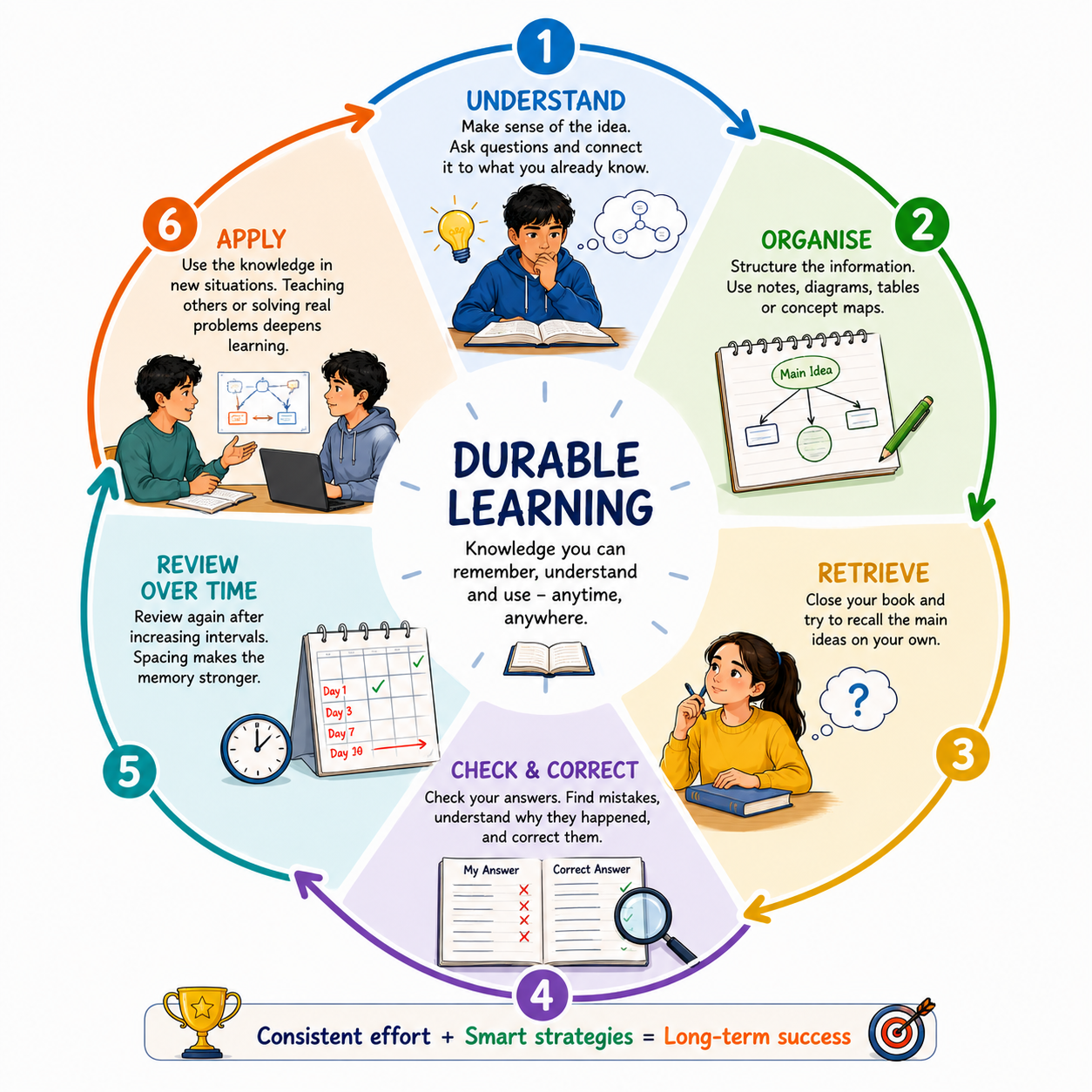
A Five-Step Method for Remembering More
A simple method can be summarised as follows:
1. Understand
Identify the meaning, purpose and structure of the lesson.
2. Organise
Divide the material into main ideas, supporting details, examples and relationships.
3. Retrieve
Close the book and recall the information independently.
4. Check and correct
Compare your answer with a reliable source and fix mistakes.
5. Review over time
Repeat retrieval after gradually increasing intervals.
These five steps are more effective than trying to force information into memory through endless repetition.
Final Thoughts
A strong memory is not simply something a person is born with. Memory can be improved by using better learning habits.
The most effective study sessions do not always feel the easiest. Rereading may feel smooth and reassuring, while self-testing can feel difficult and uncomfortable. Yet the effort involved in recalling, explaining and applying knowledge is often what makes learning last.
To remember more:
- Pay full attention.
- Understand before memorising.
- Connect new knowledge with existing knowledge.
- Recall information without looking.
- Review it across several days or weeks.
- Practise applying it in different situations.
- Learn from mistakes.
- Explain it to others.
- Protect sleep and mental energy.
The goal of learning is not to keep a page looking familiar. It is to develop knowledge that remains available when the book is closed — during an examination, in a discussion, at work or in real life.
Real learning is not measured by how many times something has been read. It is measured by whether it can be understood, remembered and used.